
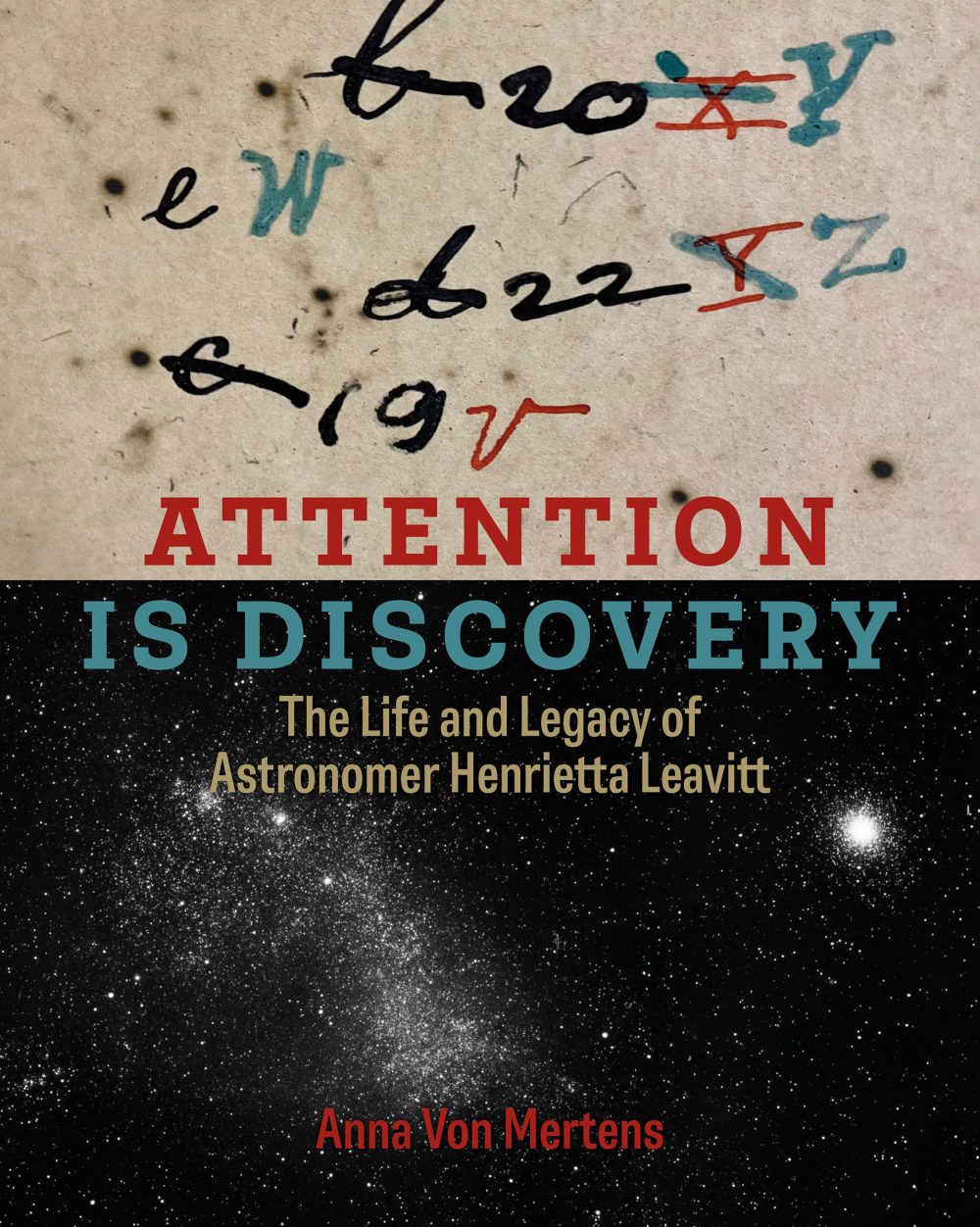
by Anna Von Mertens, Cambridge: The MIT Press, 2024, ISBN 978-0-262-04938-2, Hardbound, $35.00, US
It isn’t often that a book on astronomy is written by someone who is well-versed in art. In this case, material artist Anna Von Mertens found herself becoming engrossed in the life of Henrietta Swan Leavitt, and her work making the universe three-dimensional. She then worked her quilting magic to portray the years Leavitt worked her celestial magic, creating a visual representation of the universe.
Henrietta Swan Leavitt didn’t begin her life as one of the Harvard College “computers” intending to do anything memorable. She, like her peers, merely wanted to find a way to classify the incredible volume of glass plates taken with, among other observatories, the Bruce Astrograph of the Boyden Station of the Harvard Observatory in Arequipa, Peru. Her work with the southern hemisphere’s Magellanic Clouds resulted in a whole new version of computing astronomical distances. As mentioned in Von Mertens’s book, sadly, Leavitt died two years before Edwin Hubble’s remarkable distance discovery of the Andromeda Nebula (soon to be renamed Galaxy) using a Leavitt Cepheid variable measurement.
In addition, the author speaks of the hundreds of thousands of glass plates Leavitt and the other computers worked with. In order to document them all, the DASCH (Digital Access to a Sky Century at Harvard) project was begun; unfortunately, early work on the project had staff “clean” some of them, thus erasing valuable designations written by the early women. That was discontinued after years of protests and objections on doing so. Fortunately, some of the plates were hidden, and therefore saved, until the practice was stopped.
A very sad aspect of Leavitt’s life was that, with her early death at age 53, she could not be nominated for a well-deserved Nobel Prize.
In addition to the life of an incredible woman, the author shows numerous examples of works of art based on Leavitt’s life and work. Her incredible stitching prowess interprets the fine, patient work of the astronomer in a beautiful format. It’s not always that a book incorporating art and astronomy can be accurately captured by an author; in this case, Von Mertens’s blend of both works very well.

