
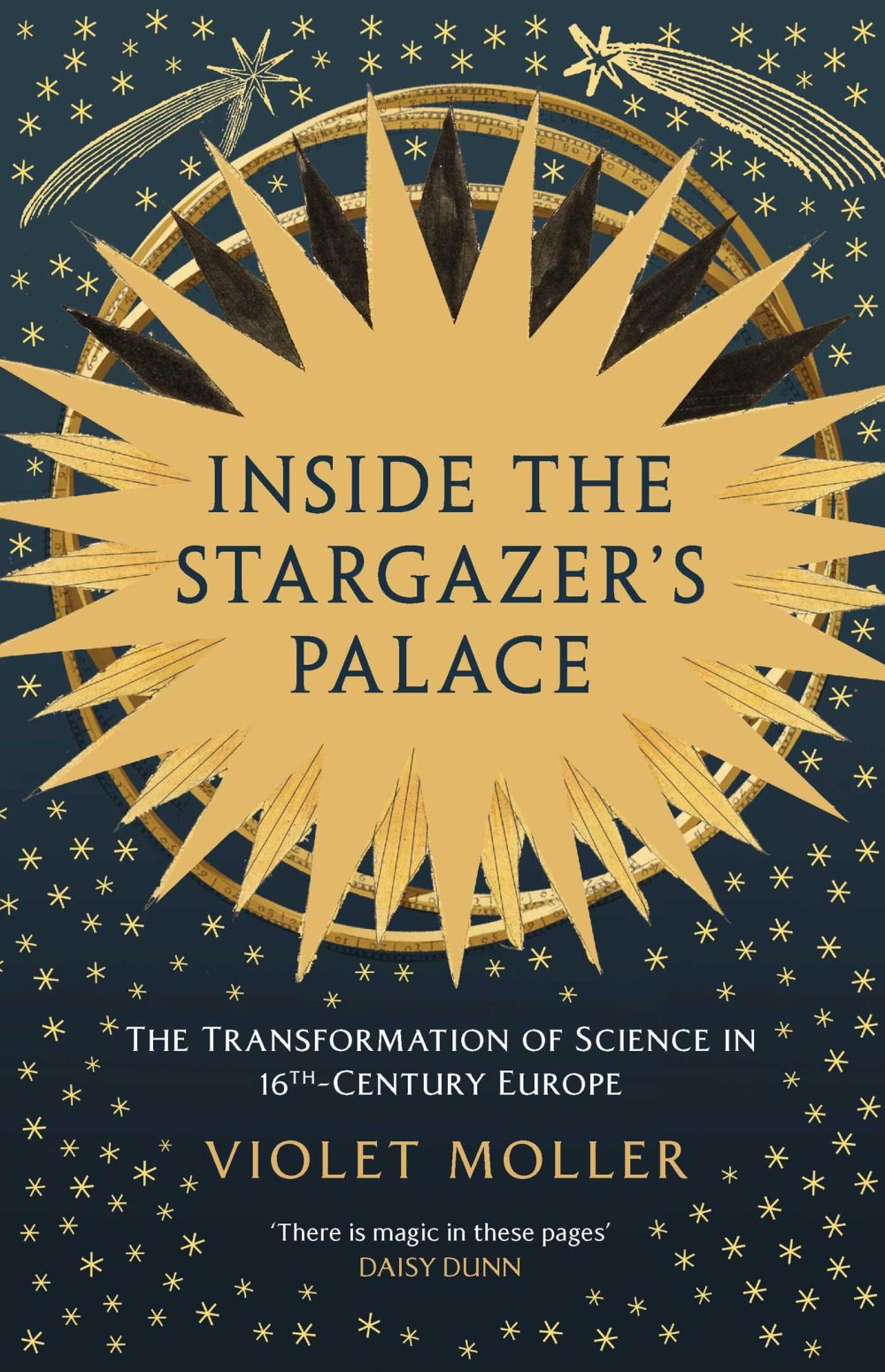
by Violet Moller, New York: Pegasus Books, 2025, ISBN 9781639368372, Hardbound, $29.95, US
Very often, when a book is listed as a compendium of historic facts, it does give a brief sample of each topic; however, in this case, the author does, in fact, pour through each section of historic interest. Her first stop, Nuremberg, introduces families within the area who established companies based around their commodities: spices, wine, copper. In 1568, a shoemaker published a book which listed over a hundred persons and their related professions.
In Louvain, we meet up with John Dee, who is featured prominently throughout this section, who desired to travel extensively to familiarize himself with both mathematical and astronomical “enlightenment.”
Then, it’s off to Mortlake, where Dee’s homestead becomes a center of knowledge in England. As it was not associated with a university or a religious institution, it became the predecessor to organizations such as the Royal Society, where those searching for knowledge could do so without restrictions.
By the 16th century, the German region of Kassel became known as a great stopping point for trade. As it grew, the ruler Wilhelm IV also made the city a center of science and mathematics. Sadly the author notes that today it is a small town, with no apparent memories of its former academic grandeur. However, she does introduce Lutheran scholar Philip Melanchthon, Martin Luther’s “right-hand man,” who, with Luther, attempted to tear down Catholicism and rebuild it, yet at the same time instill education during his lifetime.
Finally, we find ourselves in Hven and Prague, where familiar names Brahe and Kepler show up. Surprisingly, during their lives, John Dee also makes appearances; in addition, we are introduced to others, not so known, who appeared to be as richly endowed with thirsts for knowledge; again, persons not normally listed as a part of the traditional academics.
The author has, in this book, introduced the reader to both persons of previously unknown scientific knowledge, and places not genuinely known as hubs of scientific institutions. A warning to someone wanting to read this incredible book: From page one, begin a flow chart of the amazing number of persons introduced, several possibly not previously known to the reader. In addition, the information is almost too much to grasp in just one reading. Keep Inside the Stargazer’s Palace with you, and refer to it often.
